Rain-Season Roof and Gutter Checklist for Southern California Homes

Before the first real storm, clear every gutter and downspout, check that water discharges well away from the foundation, look for lifted or missing roof material and failed flashing at penetrations, reseal any open joints, and confirm attic and eave areas are dry. Doing this once in the fall prevents most of the water damage Southern California homes see all winter.
Southern California gets most of its rain in a handful of storms. That is exactly why roof and gutter problems here go unnoticed for months: a system can sit bone dry from May to October, then be asked to move thousands of gallons of water in a single afternoon. The failures we get called about after the first storm are almost never dramatic. They are a blocked downspout, a cracked sealant joint at a vent, or a downspout that has been quietly soaking the soil next to a footing for years.
This is the short, practical companion to our Southern California home maintenance calendar. It covers one job only: getting the roof and the water it sheds ready for the rain season.
When should you do this in Southern California?
Aim for late September through October, before the first significant storm forecast. Our rain season is unpredictable and shifts year to year, so treat the first forecast of a real storm as your deadline rather than a fixed calendar date. If you are already past that point and it has not rained yet, do it now. If it has already rained, do it anyway and pay closer attention to the interior signs further down this page.
One practical note: roofers and gutter crews are busiest immediately after the first storm. Booking work in September usually costs less waiting time than booking the same work in December.
The gutter and downspout checklist
Gutters do not fail because they are dirty. They fail because the water they collect ends up somewhere it should not be. Work through the whole path, from roof edge to discharge point.
Gutter checklist
- Clear the troughs. Remove leaves, needles, grit and the shingle granules that collect at low points.
- Flush each downspout. Run a hose into the gutter and confirm water actually comes out the bottom, at full flow, with no bulging or leaks at the seams.
- Check the slope. Standing water in the trough after flushing means the hanger spacing or pitch needs correcting.
- Check the fasteners. Loose hangers and pulled spikes let a full gutter sag and overflow behind the fascia.
- Look at the fascia and soffit. Soft wood, blistered paint or staining under a gutter joint means water has already been getting behind it.
- Follow the discharge. This is the one most people skip, and it matters more than any of the others.
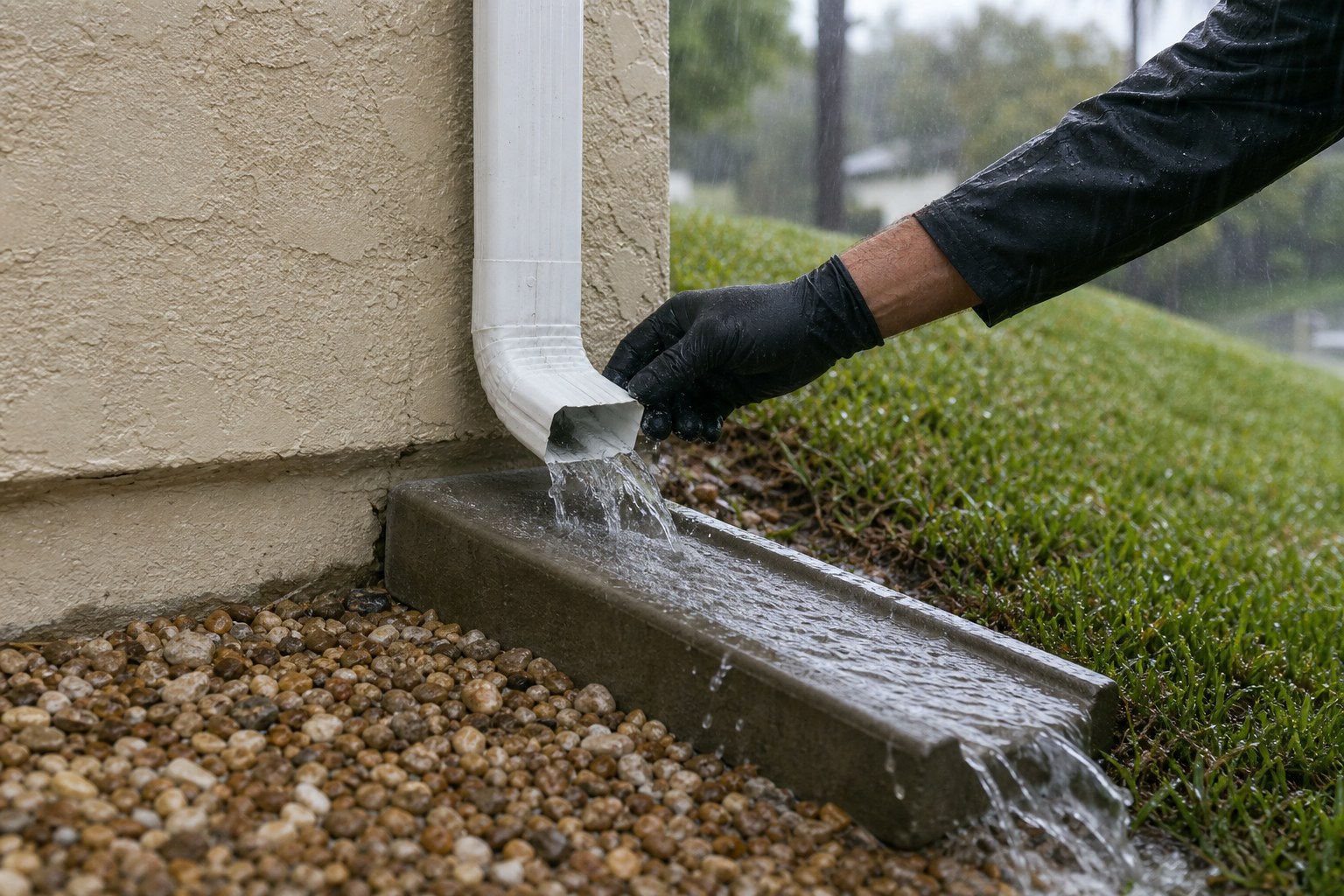
Where the water goes matters more than whether the gutter is clean
A clean gutter that dumps at the base of a wall is worse than a partially blocked one that discharges to a working area drain. Water repeatedly saturating soil next to a foundation is a soil-movement and slab-movement problem, not a housekeeping problem, and in hillside and expansive-soil areas it is the most common cause of the cracking homeowners call us about.
PixelArch LLC looks at drainage first whenever an owner reports new cracking, sticking doors or a sloping floor. Confirm that every downspout discharges onto a splash block, a pipe or a swale that carries water away from the building, that area drains and yard inlets are not packed with debris, and that no discharge point sends water toward a neighbouring property, a retaining wall or the top of a slope.
What to check on the roof
You do not need to walk the roof, and on a tile or steep roof you should not. Most of this can be seen from a ladder at the eave, an upper window, or a zoom photo from the ground.
| Look at | What is a problem | Why it matters in the rain |
|---|---|---|
| Field of the roof | Missing, cracked, slipped or lifted tiles and shingles | Wind-driven rain gets under the covering and wets the underlayment and sheathing |
| Flashing at walls and chimneys | Rust, separated joints, sealant that has hardened and cracked | Wall-to-roof junctions are the single most common leak location |
| Penetrations | Vents, pipe boots, skylights, solar mounts with degraded seals | Sun exposure kills sealant and rubber boots faster here than the roof covering itself |
| Valleys | Debris packed in the valley, worn metal | Valleys carry the highest volume of water on the roof |
| Ridge and hips | Loose ridge tiles, cracked mortar | Santa Ana winds lift loose pieces and open the roof before the rain arrives |
| Eaves and vents | Blocked, damaged or unscreened vents | Also an ember entry point in fire season, so fixing it does double duty |
Because our wind and fire season overlaps the run-up to the rains, it is efficient to combine this walk-around with the ember-resistance items in our guide to reducing wildfire damage before summer. Vent screening, clean gutters and a debris-free roof serve both purposes.
What to check inside the house
The roof tells you what could fail. The interior tells you what already has.
Interior and attic checks
- Ceiling stains, especially in corners, along exterior walls and around skylights.
- Attic sheathing: dark staining, rusted nail tips or a musty smell means water has been getting in.
- Daylight visible through the roof deck from inside the attic.
- Compressed or stained insulation under a leak path.
- Window and door head casings, where wall flashing failures show up first.
- Garage and crawlspace walls at grade, for damp lines that suggest exterior water is ponding.
An old dry stain is not urgent. A stain that is soft, growing or reappears after each storm is. Photograph and date anything you find, so next season you can tell whether it moved.
What to do during and after the first storm
The first real storm of the season is free diagnostics. If it is safe, walk the outside of the house while it is raining hard and note where gutters overflow, where water sheets off the roof edge instead of entering a gutter, and where puddles form and how long they stay. After the storm, check the same interior locations again, and write down what you saw while it is fresh. A short list of observed problems is worth far more to a roofer, or to us, than a general worry that the roof is old.
When it stops being maintenance and becomes a project
Most of this list is owner-level work or a routine service call. A few findings mean something structural or design-level is going on, and those are worth a professional look before you spend money on the symptom:
Call a professional if you see
- Sagging or visibly deflected roof planes, or a ridge line that is no longer straight.
- Repeat leaks in the same location after two or more repairs.
- Water intrusion paired with new cracking, doors that stick or floors that slope.
- Any drainage problem on a slope, near a retaining wall, or at a downhill neighbour.
- A roof you are considering replacing, if you also want to add solar, skylights, a raised ceiling or a second storey later.
That last point is worth planning around. If a roof replacement is coming, it is the cheapest moment to make structural or daylighting changes, because access and demolition are already paid for. Our notes on removing walls and structural work in a remodel and on when to start designing a project both apply here, and if fire safety upgrades are part of the picture see our guide to residential fire sprinkler systems. For owners rebuilding after a loss, the sequencing in our wildfire rebuild guide is the better starting point.
How PixelArch LLC can help
PixelArch LLC is a design and permit-documentation practice in Laguna Hills working across Orange County, Los Angeles and the Inland Empire. We are not a roofing contractor, so we have no reason to sell you a roof. Where we help is the step after the checklist: documenting existing conditions, modelling the roof and structure in Revit and BIM so a repair, re-roof or addition can be designed once and built without surprises, and preparing the drawings a building department and a contractor both need. See our architectural design services or Contact PixelArch LLC to talk through what you found.
Frequently Asked Questions About Rain-Season Roof and Gutter Prep
At least once a year, in the fall before the rain season. Twice a year if the house sits under pines, sycamores, eucalyptus or jacarandas, or if the roof has valleys that trap debris. Homes with no overhanging trees can often go a single annual cleaning, but the downspout flush test should still be done every year.
Late September through October. The goal is to be finished before the first significant storm forecast, which varies year to year. Booking a roofer or gutter crew before the first rain also means far shorter wait times than calling in December.
No, and on tile, slate, metal or steep roofs you should not. Most conditions can be assessed from a ladder at the eave, from upstairs windows, from the attic, or with zoom photographs from the ground. Walking a tile roof cracks tiles and creates the leak you were looking for.
Repeatedly saturating the soil next to a foundation can cause soil and slab movement, which shows up as cracked drywall, sticking doors and sloping floors. In expansive-soil and hillside areas it is the most common cause of the movement homeowners report to us. Where the water goes is as important as whether the gutter is clear.
Sometimes. A splash block helps on flat, well-draining ground that already slopes away from the house. If the ground is level, slopes toward the building, or the soil is clay, you generally need a pipe or swale carrying the water further away, or a connection to a working area drain. On slopes and near retaining walls, have the drainage looked at properly rather than guessed.
They reduce how often you clear the troughs but they do not remove the annual check. Fine debris and shingle granules still get through, and a clogged guard can make a gutter overflow while looking clean from the ground. If you fit them, keep flushing the downspouts every year.
Photograph and date every stain you find. A dry, hard, well-defined stain that does not change is usually historic. A stain that is soft to the touch, growing, or reappears after each storm is active. Comparing this year’s photos with last year’s is the simplest test there is.
Usually flashing and sealant at the penetration rather than the roof covering itself. Our sun degrades sealant and rubber pipe boots faster than it degrades tile or shingles, so penetrations frequently fail first on a roof that otherwise has years of life left.
Re-roofing generally requires a permit in California jurisdictions, and structural, sheathing or insulation upgrades can trigger additional requirements. The specifics vary by city and county, so confirm what applies to your address with your local building department before work starts.
If a remodel, addition, solar array, skylights or a raised ceiling are on your list within a few years, yes, plan them together. Access, demolition and inspection overlap heavily, and designing the structure once avoids paying twice to open the same roof. That is the most common piece of money-saving sequencing advice we give.
This article is general educational guidance for Southern California homeowners and is not a property-specific inspection, engineering opinion or code determination. Seasonal timing varies year to year and by location, and permit requirements for roofing and drainage work differ by jurisdiction — confirm what applies to your address with your local building department. If you observe structural movement, persistent water intrusion or slope instability, consult a qualified professional.

One comment
Pingback: Drainage, Grading and Hillside Lots in Southern California - PixelArch LLC