Reading Your Home’s Warning Signs: Cosmetic or Structural?

Most cracks, sticking doors and small gaps in a Southern California home are cosmetic, caused by seasonal moisture, curing materials and normal settling. The warning signs that deserve a professional opinion are the ones that are wide, tapered or offset, keep growing or return after repair, appear in several places in the same part of the house, or come with water problems or soil moving away from the foundation. Monitor and record what you see, fix water first, and call the right professional when signs cluster or change.
Every house sends signals. A thin line appears above a bedroom door, the back door starts to catch in January, a stain shows up on the kitchen ceiling after the first storm. Most of these are harmless. A few are the early, inexpensive-to-fix stage of a problem that becomes much harder to deal with if it is ignored for a few more seasons. The difficulty for most owners is not noticing the signs, it is knowing which ones matter.
This is the third pillar in our homeowner series, alongside the Southern California home maintenance calendar and our guide to checking a lot or fixer-upper before you buy. It is a practical way to read your own house: what each kind of sign usually means, how to tell cosmetic from structural, how to monitor what you see, and who to call when something does need attention.
Why are warning signs easy to misread in Southern California?
Houses here move for reasons that owners in wetter, colder climates rarely think about. Much of the region sits on clay soils that swell when they get wet and shrink as they dry out. A long dry summer followed by a few heavy winter storms means the ground under a house can change volume noticeably over one year, and the house moves with it. Add regular small earthquakes, hillside lots, decades of additions and remodels, and a building stock that ranges from early twentieth century raised-floor bungalows to recent slab-on-grade tract homes, and it is not surprising that cracks and sticking doors are common.
Much of what owners see is normal seasonal movement that comes and goes. The catch is that the same seasonal pattern can hide a real problem, because an owner who has seen a door stick every winter for years may not notice when it starts sticking all year, or when three other doors join it. The skill is to look for change and for patterns, not for any one crack.
Two other local factors matter. First, many houses have been altered over the years, sometimes without permits or engineering, so a sign may point to an old remodel rather than to the ground. Second, the dry climate lets a slow leak under a slab or inside a wall stay hidden for a long time.
Cosmetic, monitor or call: a simple way to sort what you see
It helps to put every sign into one of three groups. This is not a diagnosis, and it does not replace an on-site assessment, but it gives you a consistent way to decide what to do next.

| Group | What it usually looks like | What to do |
|---|---|---|
| Cosmetic | Thin cracks at door and window corners, along drywall tape joints or in fresh concrete; mild seasonal door sticking; paint and caulk separation | Record it once, repair at the next repaint, and keep an eye on it |
| Monitor | Cracks that are a little wider or longer than their neighbours; a door that sticks more than last year; a small stain with no obvious source | Mark, date and photograph it; check every few months and after heavy rain or an earthquake |
| Call | Wide, tapered, stepped or offset cracks; signs that keep growing or return after repair; several signs in one area; floors you can feel sloping; active water; leaning walls | Stop the cause if it is water, then get the right professional to look at it |
The groups are not fixed. A sign that starts as cosmetic moves to monitor if it changes, and a monitored sign moves to call if it keeps changing or other signs appear nearby. The most useful question is always: is this new, and is it getting worse?
What do cracks in walls and ceilings tell you?
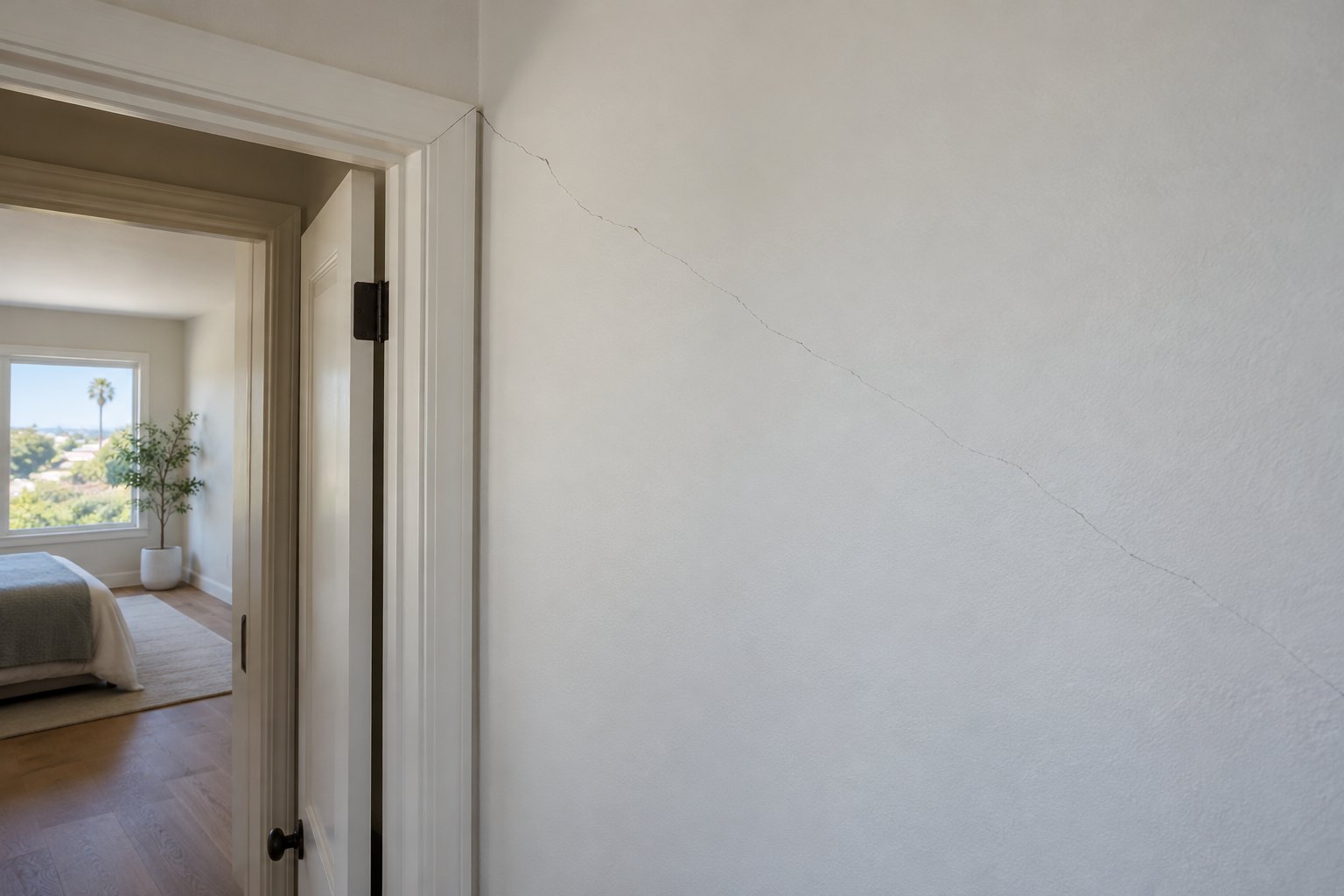
Interior cracks are the sign owners notice most, and most of them are cosmetic. Doors and windows are openings in a wall, so stress collects at their corners, and that is exactly where thin diagonal cracks tend to appear. Cracks along straight drywall tape joints, at the line where a wall meets the ceiling, and in plaster in older houses are also very common as framing dries out, temperatures change and the house settles.
Cracks deserve a closer look when they show one or more of these characteristics:
- Width or taper. A crack that is noticeably wider at one end than the other suggests one part of the wall is moving relative to another.
- Offset. If the surface on one side of the crack sits proud of the other, or a straight line such as a tile joint or trim no longer lines up, something has moved.
- Pattern. Several cracks pointing in the same direction, or cracks that repeat on the same wall upstairs and downstairs, point to a common cause.
- Return. A crack that comes back soon after a careful repair is telling you the movement has not stopped.
- Company. Cracks that appear alongside sticking doors, sloping floors or gaps at the baseboards in the same area are more significant than any of those signs alone.
Ceilings follow the same logic. Fine cracks along drywall joints are common. A ceiling that sags between joists, a crack that runs along a long straight line across several rooms, or a ceiling crack that appears together with a stain needs attention, because it may point to a framing or water problem above.
Exterior stucco has its own set of patterns, and we covered them in detail in Stucco Cracks in Southern California: When to Worry. The short version is the same: thin, random cracks are usually cosmetic, while stair-step, wide, offset or growing cracks, especially near corners and openings, are worth a professional opinion.
Doors, windows and floors: the house telling you it has moved

Doors and windows are useful because they are built square. When the frame around them moves, they stop closing cleanly. In Southern California, wood doors also swell in damp months and shrink in dry ones, so mild seasonal sticking is normal. What deserves attention is change: a door that suddenly starts sticking, several doors in one part of the house sticking at once, a latch that no longer lines up with its strike plate, or a tapered gap along the top of a door that was once even.
Floors tell a similar story. Many older houses have floors that are slightly out of level, and that alone is not a reason for alarm. Signs worth noting are a slope you can feel when walking, a ball or marble that rolls consistently in one direction, gaps opening under baseboards, a floor that feels springy or bouncy, and tile that cracks in lines across a room. In houses with a raised floor and a crawlspace, those signs can point to posts, beams or supports underneath. On a slab, they can point to soil movement.
Because sticking doors and sloping floors are among the most common questions we get, we will cover them on their own in next week’s post, including how to check them yourself. For now, the important point is that they are rarely meaningful alone. They become meaningful when they change, or when they appear together with cracks, gaps or water.
What should you look for at the foundation and slab?
A slow walk around the outside of the house is one of the most useful checks you can make. On slab-on-grade homes, look at the exposed edge of the slab where it meets the soil and at the garage floor. On raised-floor homes, look at the visible foundation wall and, if you can do so safely, the crawlspace.
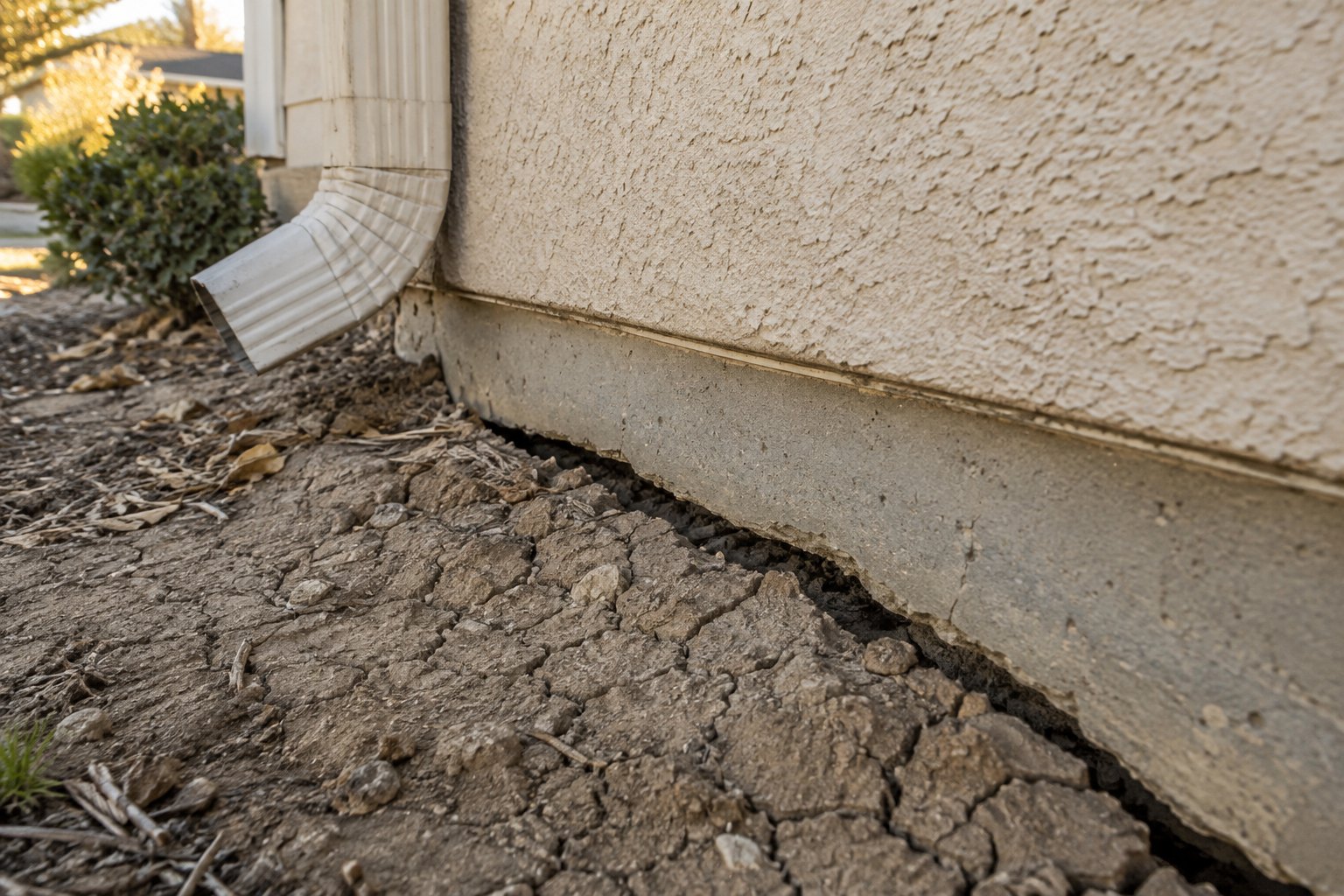
Fine cracks in concrete are very common. Concrete shrinks as it cures, and garage slabs, patios and foundation edges often show thin cracks within the first years. The patterns that point to movement are different:
- one side of a crack sitting higher than the other
- cracks that keep widening over months, or that line up with cracks in the wall above
- soil pulling away from the foundation in summer, leaving a visible gap
- water pooling against the foundation after rain, or soil sloping toward the house
- in a crawlspace: posts that lean or no longer touch the beam above, damp or rotted wood, or standing water
Soil and water are closely linked. Clay that is wet on one side of the house and dry on the other moves unevenly, and that is what cracks walls. Keeping water away from the foundation and moisture levels steady around it is the single most useful thing an owner can do, and our guide to drainage, grading and hillside lots explains how to read your own lot in a few minutes.
Outside the house: walls, chimneys, retaining walls and hardscape
The outside of a house and the land around it often show movement earlier and more clearly than the interior. Walk the full perimeter and look at the whole picture, not just the walls.
- Chimneys. Look for a gap opening between the chimney and the wall, a chimney that appears to lean, or cracked and missing mortar. Masonry chimneys are vulnerable in earthquakes, so changes deserve prompt attention.
- Retaining walls. Leaning, bulging, new cracks, or weep holes that never drain all suggest the wall is under more pressure than it was built for, often from water behind it. On hillside lots this is a priority.
- Hardscape. Patios, walkways and driveways that tilt toward the house, separate from it or crack in a pattern can show where water or soil is moving.
None of these is automatically serious. What makes them useful is location. If the cracked patio, the leaning garden wall and the sticking bedroom door are all on the same side of the house, they are probably connected, and that side is where an investigation should start.
Why is water the warning sign behind most of the others?

If there is one theme in this article, it is water. Roof leaks rot sheathing and framing. Plumbing leaks soften subfloors and feed mold inside walls. Poor drainage makes clay soils swell and shrink and moves the foundation. Many of the cracks and sticking doors owners worry about turn out to have water somewhere in their history.
Water signs to take seriously, even when they look small:
- ceiling or wall stains, especially rings that grow after rain
- paint that bubbles or peels on interior walls, or baseboards that swell
- a persistent musty smell in a room, closet or crawlspace
- white powdery deposits on concrete or masonry, which show that water has passed through and evaporated
- soft or discolored wood at window sills, door thresholds, decks and the bottom of exterior walls
- a water bill that rises without a change in use, or the sound of running water when everything is off
The rule is simple: stop the water first, then deal with the damage. A cosmetic repair over an active leak only hides the evidence. Before each rain season, run through our rain-season roof and gutter checklist, and after the first heavy storm, walk the house inside and out to see where water actually went.
What can the roof line and attic tell you?
From the street, look along the ridge and the eaves. They should look straight. A ridge that dips in the middle, a roof plane that looks wavy, or a fascia board that sags between supports can point to framing that has deflected, often because of long-term water damage or loads added over the years. Look for staining or rot at the eaves and under overhangs, which is where gutters and roof edges usually fail first.
If you can safely look into the attic with a flashlight, check for daylight where there should not be any, dark water stains on the underside of the roof sheathing, damp insulation, and rafters or trusses that are cracked, split or have been cut. Do not walk on ceiling joists or insulation unless you know where you are stepping, and leave anything electrical alone.
Signs of past work that may never have been reviewed
Some warning signs have nothing to do with soil or water. They come from earlier work that changed the structure without the right design or permits. Typical examples include a wall that was removed to open a kitchen and now has a ceiling that dips across the opening, a garage converted into living space with floors at odd levels, an addition whose roof meets the original house with a persistent leak, and sagging over a large opening that was widened for a sliding door.
If you suspect a sign is linked to an old remodel, the permit history is a good place to start. Our guide to spotting unpermitted work explains what to look for and how to request records, and our article on removing walls without compromising the structure explains why openings in load-bearing walls need proper design. Work that was never permitted is often fixable, but it needs to be understood first.
How do you monitor a warning sign properly?
The difference between worry and information is a record. A professional can tell you much more from a dated series of photos than from a description of a crack you noticed at some point last year. Monitoring is simple and costs almost nothing:
- Mark it. Draw a small pencil line at each end of a crack and write the date beside it.
- Photograph it. Take the photo straight on, with a coin or ruler beside the crack for scale, and a second wider photo that shows where it is in the room.
- Measure what you can. For a door, note where it catches. For a floor, a level or a marble in the same spot each time is enough to see change.
- Repeat on a schedule. Check every few months, and always after heavy rain, a long dry spell, or an earthquake.
- Keep one log for the whole house. A single note or spreadsheet with dates, locations and photos makes patterns visible.
Tie the checks to a routine you already have, such as our maintenance calendar. The same photos are also part of a good home record, which we covered in how to document your home before a loss.
When is a warning sign urgent?
Most signs give you time to observe and plan. A few do not. Treat these as urgent and act first, investigate second:
- a smell of gas, or a hissing sound near gas lines or appliances: leave the house and contact the gas utility or emergency services
- sparking, scorching or a burning smell from outlets, switches or the electrical panel
- a crack or gap that opens quickly, or a door that suddenly will not open or close after an earthquake
- a ceiling that bulges with water, or a section that is visibly sagging
- a retaining wall, chimney or slope that has shifted visibly, especially during or after heavy rain
In those cases, keep people away from the affected area, call the right emergency contact, and only then arrange an assessment. Photograph everything once it is safe; those records matter for repairs, permits and insurance.
Who should you call for each kind of sign?
Calling the right person first saves time and money. As a starting point:
| What you see | Who to call first | Why |
|---|---|---|
| Roof leak, ceiling stain after rain, damaged flashing | Licensed roofer | Stops the water and identifies the entry point |
| Leak with no rain, rising water bill, damp walls or floors | Licensed plumber, including leak detection | Finds supply, drain or slab leaks |
| Soft wood, frass, mud tubes, rotted sills | Licensed pest inspector | Separates termite and dry rot damage from other causes |
| Widening, tapered or offset cracks; sloping floors; leaning walls | Structural engineer | Assesses whether the structure is moving and why |
| Soil pulling away, slope movement, recurring foundation cracks | Geotechnical engineer, often with the structural engineer | Evaluates soils, drainage and slope conditions |
| Repairs that change layout, structure or require permits | Architectural design team | Documents the house, coordinates engineers and prepares permit drawings |
| Questions about past permits or what applies to your address | Local building department | Holds permit records and sets local requirements |
If you are not sure, start with the person who can stop any active water, and let the evidence tell you who comes next.
How PixelArch LLC helps owners read their homes
Owners often send us a handful of photos and a simple question: is this something to worry about? Our first step is to look at the pattern, not the individual crack. We ask where the signs are, when they appeared, whether they have changed, and what has happened to the house and the lot over the years, including remodels, additions and drainage changes.
When a house needs a closer look, PixelArch LLC can visit, measure and prepare existing-condition drawings, and where the project justifies it, build a BIM model in Revit that records the structure, openings and levels as they actually are. That gives everyone who works on the house the same accurate picture. When the signs point to movement, we coordinate the structural and, where needed, geotechnical review, and if the fix requires permits, PixelArch LLC prepares and coordinates the construction documents, with the applicable plans and calculations reviewed, signed and stamped by licensed professionals as required for the project and jurisdiction.
An owner’s warning-signs checklist
Twice a year, and after every major storm or earthquake
- Walk the outside: foundation edge, soil line, drainage, retaining walls, chimney and roof line.
- Walk the inside: wall and ceiling cracks, door and window operation, floors and baseboard gaps.
- Check for water: stains, peeling paint, musty smells, damp crawlspace, unexplained water use.
- Mark, date and photograph every crack or change, and keep one log for the whole house.
- Move any sign that is changing from cosmetic to monitor, and from monitor to call.
- Stop active water before any cosmetic repair.
- Check permit history if a sign lines up with an old remodel or addition.
- Call the right professional when signs cluster, grow or return after repair.
Not sure what your house is telling you?
Send us a few photos, the address and a short description of what you have noticed and when. We will tell you whether it looks like something to monitor, who should look at it, and how we can help if it turns into a project. If anything looks unsafe, call the utility or emergency services first. Questions about permits for your address belong with your local building department. Contact PixelArch LLC.
Frequently Asked Questions About Home Warning Signs
The signs that most often deserve a professional opinion are cracks that are wide, tapered, stepped or offset; cracks that keep growing or come back after repair; doors and windows that suddenly start sticking across several rooms; floors that slope or bounce noticeably; gaps opening between walls, ceilings and floors; and soil or hardscape moving away from the foundation. One sign alone is often harmless. Several signs in the same part of the house are what matter.
Usually, yes. Thin cracks at the corners of doors and windows, along taped joints and where walls meet ceilings are very common as framing dries, temperatures change and the house settles. Mark the ends, photograph them with a date, and watch them. If they widen, lengthen, offset or reappear soon after a careful repair, have them looked at.
Wood doors and frames take on moisture in damp months and shrink again in dry months, so mild seasonal sticking is common in Southern California. Sticking that appears suddenly, affects several doors in one area, or comes with new cracks or sloping floors is different, and it is worth having the structure and drainage checked. We cover doors and floors in more detail in a separate post.
Not necessarily. Concrete shrinks as it cures, and fine cracks in garage slabs and patios are very common. Pay attention when one side of a crack sits higher than the other, when a crack keeps widening, or when slab cracks line up with cracks in the walls above. Those patterns suggest movement rather than shrinkage.
Water is behind many of the warning signs people see. Leaks can rot framing and subfloors, and water collecting at the foundation can make clay soils swell and shrink, which moves the house. Fixing roof, plumbing and drainage problems early is one of the most effective ways to protect the structure.
Walk the house and photograph everything, inside and out, as soon as it is safe. Look for new or wider cracks, doors that no longer close, gaps at the foundation, a chimney that has shifted, and any gas smell. If anything looks unsafe or you smell gas, leave the house and contact the utility or emergency services. Otherwise, have new cracks reviewed and keep the photos for your records and insurer.
It depends on the sign. Roof, plumbing and pest problems usually start with the right trade. Signs of movement, such as widening cracks, sloping floors or a leaning retaining wall, call for a structural engineer, and possibly a geotechnical engineer for soils. If a repair turns into a design or permit project, an architectural design team can document the house, coordinate the engineers and prepare the drawings.
Mark the ends of the crack in pencil with the date, photograph it with a coin or ruler beside it for scale, and repeat every few months and after heavy rain or an earthquake. Keep notes in one log for the whole house, so you can see whether several signs are changing together. That record is very useful to any professional you call.
Yes, but sellers are generally expected to disclose known material issues, and buyers will look for them during inspections. Investigating early lets you understand the cause, decide whether to repair, and present clear information instead of an open question. Disclosure requirements are a legal matter, so ask your agent or a real estate attorney what applies to you.
We can review your photographs, visit the house, prepare existing-condition drawings and, where it helps, a BIM model in Revit that records the structure as it stands. When an engineer is needed, we coordinate the structural or geotechnical review, and if repairs require permits we prepare the drawings, with the applicable plans and calculations reviewed, signed and stamped by licensed professionals as required for the project and jurisdiction.
This article is general educational guidance for Southern California homeowners. It cannot diagnose a specific house, and nothing here replaces an on-site assessment. Structural, geotechnical, electrical, gas and fire safety questions must be assessed by appropriately licensed professionals. Building code and permit requirements differ by city and county, so confirm what applies to a specific address with the local building department. If you smell gas, see sparking, or a structure looks unsafe, leave the area and contact the utility or emergency services first.