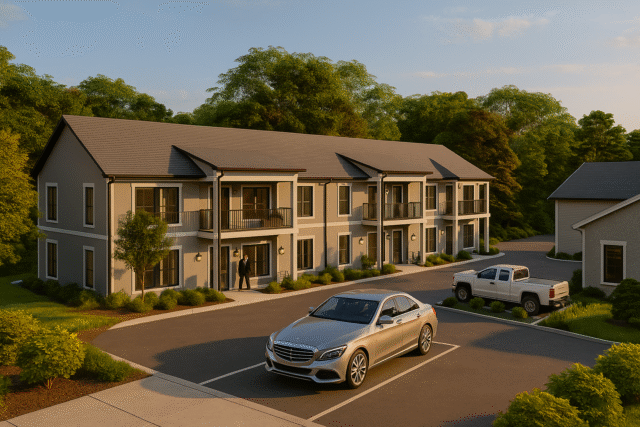
Mixed-use development only succeeds when design decisions support approvals, construction, leasing, and long-term operations—not just aesthetics.
In this case study, PixelArch partnered with an Orange County developer to redesign a mixed-use concept so it would perform better in the real world: clearer entitlement strategy, stronger ground-floor retail usability, and a more buildable documentation path.
Project Snapshot
- Project type: Mixed-use (residential + ground-floor retail)
- Location: Orange County, California
- Client: Private developer
- Scope: Architectural redesign, entitlement support, and construction documentation
- Status at kickoff: Early concept with planning and circulation constraints
The Core Challenge
The initial concept had potential but lacked commercial alignment in key areas. The developer needed a plan that reduced risk before advancing too far into approvals and technical detailing.
Primary issues identified:
- Unit and commercial program balance did not fully match local demand patterns
- Retail visibility and access at street level needed improvement
- Vehicle and pedestrian circulation had conflict points
- Entitlement narrative needed better clarity for smoother agency review
- Documentation strategy required tighter constructability logic
PixelArch Approach
PixelArch treated the project as a business-aligned design assignment, not just a drawing exercise. The redesign process focused on four outcomes: market fit, entitlement clarity, buildability, and operating value.
1) Program Realignment for Market Fit
We re-evaluated the residential and commercial program using local context and likely leasing behavior. The objective was to improve practical absorption potential while preserving project identity.
2) Ground-Level Performance and Circulation
The design team reworked frontage and site movement patterns to support both resident experience and retail function. This included cleaner wayfinding logic, improved visibility, and reduced friction between user groups.
3) Entitlement-Ready Communication
Because approval delay is a major cost driver, PixelArch structured the package around review-readiness. That meant clearer code narratives, stronger presentation clarity, and response planning for agency comments.
4) Construction Documentation with Contractor Usability in Mind
Documentation strategy emphasized coordination quality and field usability. The result was a cleaner handoff to preconstruction teams and fewer interpretation risks during execution.
Results and Value Created
While final commercial outcomes always depend on market timing and execution, the redesign delivered immediate project-level advantages:
- A more market-aligned mixed-use program
- Improved ground-floor retail usability and visibility
- Better entitlement communication quality
- A stronger, more construction-ready documentation pathway
Why This Matters for Orange County Developers
In competitive Southern California submarkets, mixed-use projects are judged by performance across the full lifecycle. Design quality matters—but so do entitlement speed, leasing practicality, and construction clarity.
This is where integrated architecture support creates measurable value: reducing downstream change risk, improving decision confidence, and helping the project stay commercially viable from concept to delivery.
Planning a Mixed-Use Project?
If you are evaluating a mixed-use opportunity and want to de-risk design decisions early, PixelArch can help.
Request a consultation to review your site strategy, entitlement approach, and documentation plan before costly revisions occur later in the cycle.